I attended a webinar recently that stayed with me far longer than most.
Not because it introduced radical new technology. Not because it had a provocative keynote or a clever product demo. It stayed with me because it articulated something I have been trying to express for years — something that sits at the heart of what we do in media intelligence and what we are at risk of getting catastrophically wrong as AI reshapes our field.
The conversation kept returning to one idea: the pressure clients feel to have certainty, and the pressure that puts on us to provide it — even when the evidence doesn’t support it.
In media intelligence, we often face pressure to provide definitive answers. But our role isn’t to force certainty — it’s to provide the most reliable direction based on the available evidence.
— Renuka , Nemi Insights · July 2026I have been in media intelligence, media monitoring, and outsourced delivery operations for over 16 years. I have worked with brands across sectors, delivered intelligence that shaped real decisions, and watched what happens when that intelligence is shaped more by what clients want to hear than by what the data actually shows.
The consequences are rarely spectacular. They are quiet. A narrative that looked positive wasn’t tracked in regional languages, so the risk wasn’t spotted. A crisis was reported as “contained” because the English-language numbers said so — while the vernacular conversation was still burning. A competitor’s coverage spike was averaged into a composite score and disappeared. Decisions got made. Outcomes diverged from expectations. Trust eroded.
And the industry moved on to the next brief.
The Industry Is Having an Honest Conversation — Finally
What gives me hope is that this conversation is now happening at the highest levels of our profession. AMEC AI Day 2025 in London brought together more than 200 PR, communications, media intelligence, and data professionals for a full day on AI’s real-world role in measurement. The sessions weren’t theoretical — they were about practical, honest integration of AI into evaluation frameworks that still prioritise rigour and human judgment.
And just this week — 13 July 2026 — AMEC launched the GEO Hub: a dedicated framework for measuring AI-led discovery with rigour and consistency. The description they used stopped me: “helping practitioners move beyond simplistic visibility scores and focus on what really matters: reputation, credibility, influence and organisational outcomes.”
That sentence could apply to everything I believe about this industry. Move beyond simplistic scores. Focus on what really matters.
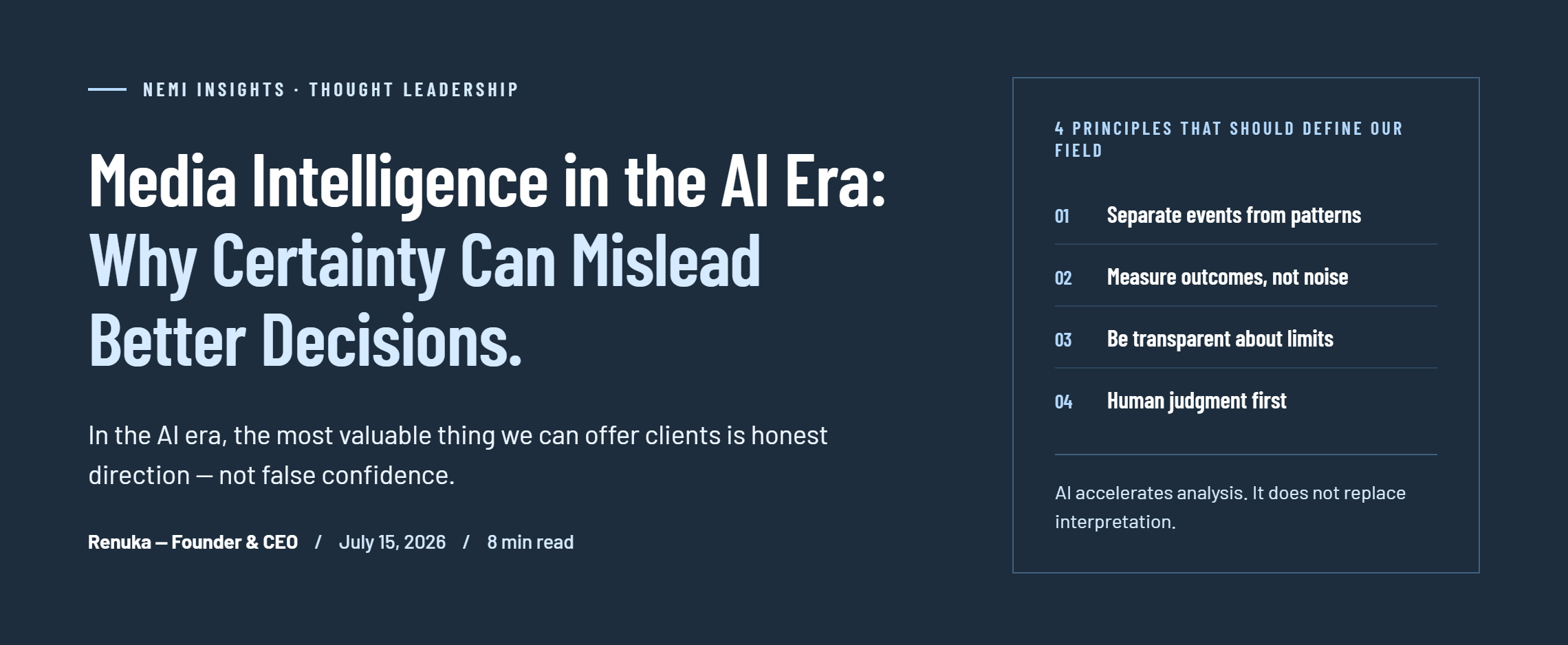
Four Principles That Should Define Our Field
The webinar crystallised four takeaways that resonated with everything I have learned across 16 years in this space. I want to share them here — not as abstract wisdom, but as the operating principles we have embedded into how Nemi Insights works.
Why Certainty Feels Good and Costs You Everything
I understand the pull of certainty. I have been in rooms where a client needed a clear answer before a board meeting. I have felt the pressure to deliver a verdict when the data was honestly pointing in two directions at once. I have seen what happens when analysts cave to that pressure — when the report says “positive” because that’s the direction the numbers mostly point, even though three significant regional outlets are running a narrative that will matter enormously in six weeks.
The most dangerous sentence in media intelligence is “the coverage was broadly positive.” Broadly positive is not an answer. It is an averaging of everything into the sound of nothing.
— Renuka, Nemi InsightsThe certainty trap operates on a simple mechanism: clients reward confident answers in the short term. If you say “this is fine,” and nothing immediately terrible happens, you look right. If you say “this needs watching,” and nothing immediately terrible happens, you look overly cautious. The incentive structure punishes nuance.
But media intelligence is not about predicting individual events. It is about identifying the conditions that make events more or less likely — and helping organisations position themselves accordingly. That is a probabilistic function, not a deterministic one. Treating it as deterministic — giving false certainty to satisfy short-term client comfort — is how catastrophic surprises happen.
AI Accelerates. It Does Not Interpret.
The arrival of AI in our industry has made the certainty trap more dangerous, not less. AI systems produce confident-sounding output by design. Ask an AI model to summarise the media landscape for a brand and it will produce a fluent, structured, apparently authoritative answer. It will not tell you where the gaps are. It will not flag the regional-language sources it could not process. It will not surface its own uncertainty about whether a cluster of similar articles reflects genuine organic coverage or a coordinated pattern.
At AMEC AI Day 2025, Ant Cousins from Meltwater made a point that resonated with me: the human role should shift from “navigating complex interfaces” to “focusing on what really matters — interpretation.” That is exactly right. AI does not take the human out of media intelligence. It changes what the human needs to bring.
Ingesting thousands of articles simultaneously · Detecting volume anomalies and coverage spikes · Classifying sentiment at scale across languages · Identifying entity mentions and topic clusters · Deduplicating syndicated content · Generating first-draft summaries and trend reports · Flagging items for human review
Understanding why a story matters in a specific regional or cultural context · Distinguishing genuine community concern from coordinated activity · Knowing which sources carry real authority in a local market · Interpreting tone in languages where sentiment models are weak · Connecting media signals to actual business outcomes · Deciding what to tell the client and how to frame it honestly
In India specifically, the second list is longer. Our media ecosystem is too linguistically diverse, too locally contextual, and too regionally differentiated for any AI system to handle the interpretation layer without human oversight. A spike in Telugu-language coverage about a food brand might mean a recipe went viral, a quality concern was raised, or a regional distributor was in the news — and the right client response is completely different for each. AI can surface the spike. Only a human analyst who understands that market can tell you what it means.
This is why at Nemi Insights, our NIA platform — despite monitoring 2,400+ sources across 14+ Indian languages — pairs every automated output with human analyst verification. Not because we distrust the technology. Because we know where its limits are, and we are honest about them.
Trust Is Built on Interpretation, Not Data Volume
Trust is built not only on the quality of our data but on the honesty of our interpretation. The two are not the same thing — and confusing them is the most common mistake in this industry.
— Renuka , Founder & CEO, Nemi InsightsYou can have the most comprehensive media monitoring platform in the market — 2,400 sources, 14 languages, real-time alerts, AI-powered sentiment — and still betray your client’s trust by telling them what they want to hear instead of what the data actually shows.
Conversely, you can have modest coverage and significant gaps in your dataset, and still be a trusted intelligence partner — if you are transparent about what you know, clear about what you don’t, and consistent about separating evidence from inference.
The clients who have stayed with us longest are not the ones for whom everything always worked out. They are the ones who, at some point, we told an uncomfortable truth — and who came back because they knew we would tell them another one when it mattered.
It means saying “this coverage is broadly positive in English, but we are seeing a different pattern in Marathi and Tamil, and we don’t yet have enough data to know which direction will dominate.” It means putting a confidence level on every signal. It means the daily brief sometimes says: “We need 48 more hours of data before we can tell you whether this is a trend or a spike.” It means the analyst who writes the report has the standing to say “I don’t know” — and the organisation behind them has built that honesty into their culture, not just their process.
In India, the Stakes of Getting This Wrong Are Higher
Everything I am describing matters everywhere. In India, it matters more.
India’s media landscape is the most linguistically complex and structurally diverse in the world. It is not one media market — it is 28 state-level markets, each with its own dominant regional language, its own journalism culture, its own trust hierarchy, and its own narrative dynamics. A story that is “resolved” in English-language national media may still be actively spreading in Odiya or Punjabi press. A sentiment shift your dashboard shows as “stable” may be masking a serious regional concern that your monitoring system simply isn’t reaching.
This is not a theoretical risk. It is a structural feature of India’s media ecosystem that every intelligence provider operating here needs to be honest about — and that clients need to understand before interpreting any report as a comprehensive picture.
What This Means for How We Work
Separating events means your reporting structure does not allow distinct coverage moments to be averaged together. Each significant story gets its own thread, timeline, audience analysis, and recommended response — regardless of whether the aggregate trend looks positive.
Measuring outcomes means every intelligence brief connects — even tentatively, even with acknowledged uncertainty — to the business question the coverage is relevant to. Not just “how much coverage did you get” but “what did this coverage do, and for whom.”
Being transparent about data limits means every report includes a section on coverage gaps, language limitations, and confidence levels. Not buried in a footnote — front and centre, before the findings.
Keeping human judgment central means the analyst, not the algorithm, signs off on the interpretation. It means building teams that have the standing and safety to say “this signal is ambiguous” rather than defaulting to the nearest confident-sounding narrative.
The Most Important Sentence in Any Media Intelligence Report
After more than two decades in media intelligence, media monitoring, and outsourced delivery operations, I have read thousands of reports, written hundreds, and worked with teams that produced some excellent intelligence and some that — despite the best intentions — gave clients a false sense of confidence when the honest answer was “we need more data.”
The most important sentence any intelligence analyst can write is not the headline finding. It is the one that says: “Here is what this data shows, here is what it cannot tell us, and here is our best judgment given those limits.”
That sentence is uncomfortable to write. Clients sometimes push back on it. But it is the sentence that distinguishes intelligence from noise — and it is the sentence that, over time, builds the kind of trust that no dashboard metric can manufacture.
As our industry embraces AI, that sentence matters more, not less. AI can produce fluent, confident, well-structured analysis at extraordinary speed. The question is whether there is a human behind it willing to say: “And here is where we are uncertain.”
AI accelerates analysis. It does not replace the honesty of interpretation. That is still, and will remain, a human job.
— Renuka , Nemi Insights · July 2026
Renuka founded Nemi Insights in 2016 after more than a decade in media intelligence and outsourced delivery operations. She built Nemi specifically for India’s linguistic complexity — monitoring 2,400+ sources across 14+ languages with a platform that pairs AI analysis with human judgment. She writes and speaks on honest measurement, AI’s role in communications intelligence, and the multilingual reality that most global platforms ignore.